
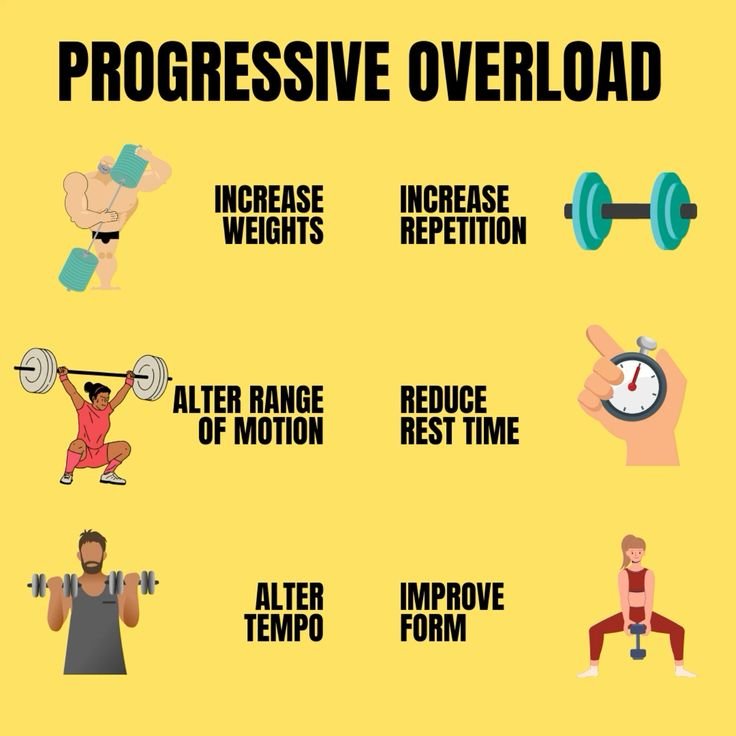
What is Progressive Overload?
Progressive overload is a fundamental principle in physical training that involves gradually increasing the demands placed on the body during exercise. Simply put, it is the process of consistently challenging your body to adapt by increasing the intensity, duration, frequency, or type of exercise you perform. This method is crucial not only for weightlifters but also for anyone looking to improve their overall fitness.
Thank you for reading this post, don't forget to subscribe!The core idea behind progressive overload is that the body requires a stimulus to grow stronger and more capable. Without increasing the workload over time, your body reaches a plateau, where no significant improvements in strength, endurance, or muscle mass occur. Therefore, it’s essential for anyone engaging in physical activities, whether you are a seasoned athlete or a beginner, to effectively implement this principle into your training routine.
Progressive overload can take various forms. For instance, in resistance training, this might mean lifting heavier weights as your strength improves. Alternatively, if you are focusing on cardiovascular fitness, you might increase your running distance or decrease your mile time as your endurance builds. Each small increment can contribute to substantial gains in performance over time, making the concept of progressive overload vital for sustained progress.
Additionally, it’s important to note that progressive overload is not solely about increasing intensity; it can also involve varying your workouts. Changing your exercises, incorporating different techniques, or altering the rest periods can yield beneficial results. By continually challenging your body with new stimuli, you promote adaptations that are key to achieving long-term fitness success.
The Science Behind Progressive Overload
The principle of progressive overload is rooted in the physiological response of muscles to stress and strain. When muscles are subjected to stress—such as weightlifting or various forms of physical activity—they respond through a process known as hypertrophy, where muscle fibers repair and grow stronger. This biological adaptation ensures that the body becomes more capable of handling similar stressors in the future; it is this principle that forms the foundation of progressive overload.
Over time, to continue achieving improvements in strength or endurance, it becomes essential to increase the resistance or intensity of the exercises performed. This does not strictly mean lifting heavier weights; it can also refer to increasing the duration, frequency, or intensity of aerobic activities, for example. The body recognizes increased demand, prompting it to adapt quickly, which can manifest as increased muscle mass, improved endurance, or enhanced performance in daily activities.
Interestingly, progressive overload can be applied outside traditional weight lifting, such as in activities like walking, running, or even household chores. When one gradually increases the distance walked, the speed of a run, or the complexity of a task performed, muscles are still being challenged. Each incremental step in resistance or intensity prepares the body for more significant demands, thus falsely correlating a lack of interest in weight lifting with the impossibility of utilizing progressive overload.
To simplify, think of progressive overload like climbing a staircase; one must take each step higher to reach the next level. By consistently increasing the challenge placed on muscles or the body, one can successfully enhance the overall physical capacity—even in non-strenuous activities. Understanding this scientific basis allows non-lifters to appreciate the broader applicability of progressive overload in their fitness journey.
Applying Progressive Overload in Everyday Life
Progressive overload, a fundamental principle usually employed in fitness and strength training, can also be effectively integrated into daily life by individuals who do not lift weights. This approach enables one to enhance their physical capabilities gradually without the need for a gym. One practical method is to increase physical activity during daily chores. For instance, instead of merely completing tasks at a comfortable pace, individuals can strive to perform household chores—such as vacuuming or gardening—more vigorously and for longer durations. This not only improves cardiovascular fitness but also builds stamina over time.
Another effective application of progressive overload can be observed in walking routines. Individuals can begin by tracking their current walking speeds and distances. Gradually increasing either the pace or the distance walked from sessions to sessions can significantly enhance cardiovascular health and muscle endurance. For example, if one typically walks for 20 minutes at a moderate speed, the next target might be to walk the same distance in 18 minutes or to extend the duration to 25 minutes. This continuous challenge to the body allows for adaptation and growth.
Incorporating new exercises into one’s fitness regimen is yet another way to apply the principles of progressive overload. Non-lifters may consider activities such as yoga, bodyweight exercises, or resistance bands—starting with basic movements and then progressing to more challenging variations. Focusing on form and gradually increasing the number of repetitions or the complexity of the exercises can lead to improved strength and flexibility. Moreover, integrating short bursts of high-intensity movements, such as sprinting during a leisurely walk or increasing the incline on a treadmill, can further enhance physical exertion while introducing variety to the fitness routine.
Common Myths and Misconceptions about Progressive Overload
Progressive overload is often surrounded by various myths and misconceptions that could deter individuals, particularly non-lifters, from engaging in physical activity. One of the most prevalent myths is the belief that effective exercise requires lifting heavy weights. Many people equate progressive overload with solely increasing weight on the barbell, which can create unnecessary fear and a misconception that only those who lift heavy can benefit from this principle.
In reality, progressive overload can be applied through multiple facets of training that do not necessarily involve weights. For example, one could increase the number of repetitions or sets within their routine, enhance the intensity of exercises by reducing rest time, or improve their overall technique and form. Such adaptations are significant for anyone wishing to enhance their fitness level, regardless of their experience.
Another common misunderstanding is that progressive overload is essential only for serious athletes or bodybuilders. While these individuals certainly utilize this method to achieve their specific goals, the underlying principle of gradual improvement applies to everyone, regardless of fitness aspirations. Whether one aims to lose weight, gain muscle, or improve endurance, progressively challenging the body is instrumental in fostering lasting change.
Furthermore, some might believe that one has to consistently push their limits to achieve results. However, true progress can be more about focusing on consistency and a balanced approach rather than simply chasing heavier weights. Incorporating variety, allowing for recovery, and setting realistic and achievable fitness goals can make progressive overload a more inclusive and approachable concept for all fitness levels.

